Refraction — the glasses Rx
The Refraction tab is where the doctor lands the glasses prescription. It's structured as a top-down flow: rough retinoscopy → dry manifest → wet (cyclo) → Final.
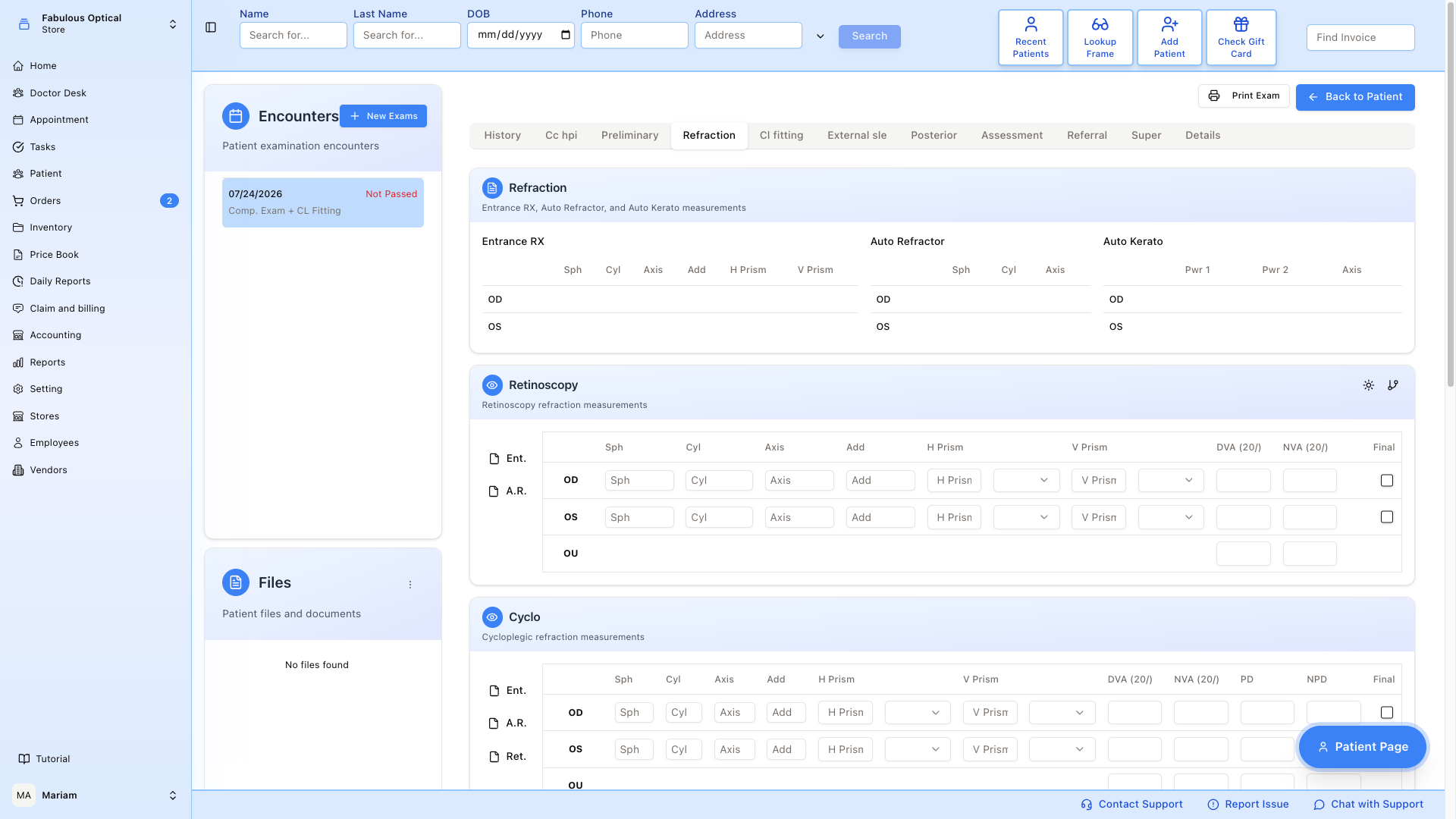
Reference row (top)
Three side-by-side widgets show what the patient walked in with:
- Entrance RX — glasses Rx the patient's currently wearing (or entered from their existing glasses).
- Auto Refractor — the machine reading.
- Auto Kerato — corneal curvature reading (Pwr 1 / Pwr 2 / Axis).
These are pre-filled from the Preliminary tab if the tech already entered them.
Retinoscopy
Doctor's rough starting point. Each row is one eye (OD / OS) plus an optional OU. Columns: Sph · Cyl · Axis · Add · H Prism · V Prism · DVA · NVA. The Final checkbox on the right marks which row is the one you're carrying forward.
The Ent. and A.R. rows on the left let you copy the Entrance Rx or Auto-Refractor value into that row as a starting point.
Manifest / Cyclo / Final
Same table layout, one section per stage of the refraction:
- Manifest — dry (non-dilated) subjective refraction.
- Cyclo — refraction under cycloplegia (dilated pupils).
- Final — the Rx you're actually giving the patient. This is what prints on the glasses order.
Fill any subset — SightHub doesn't force you to enter every stage. The Final section is the one billing/orders will pick up.
Dr Note
Free-text field at the bottom for anything Rx-related the numbers don't capture (e.g. "PATIENT WANTS PROGRESSIVES", "TRY 0.25 LESS CYL IF NOT TOLERATED").
Creating the actual glasses order
The Final Rx here is the source of truth for glasses. Once the exam is signed, use Create Rx on the patient card or New Order in the Orders module — the Rx numbers will pull from this tab.